Teachers have busy lives, so, oftentimes, we get free online handouts ready to be used. Isn’t it easier to get a handout with all the images you need, instead of creating a whole new one from scratch? Of course, it is! I do that all the time.
However, how inclusive (or exclusive) are the images we find in some ready-made handouts?
Images are very powerful and they might speak louder to some of our students than we could possibly imagine. According to Cambridge Dictionary, image is “a picture in your mind or an idea of how someone or something is”.
This is where the problem lies. We see the world through cultural lenses and these lenses might be very biased since they are heavily shaped by our culture and we use them to decide what we perceive as right, wrong, acceptable or unacceptable.
Having in mind we are all biased somehow, if you were to teach physical traits such as slim, fat, short, tall, beautiful, or ugly, which pictures would you use to help your students visualise the new vocabulary? Try and close your eyes for a moment and imagine the images you would pick on the internet to create your own handout from scratch.
While designing a course on Diversity and Inclusion, I came across very interesting ready-made handouts and I am here to share two of them with you.
Handout 1: Analyse the picture before reading the next paragraph. How many stereotypes can you see in the handout?
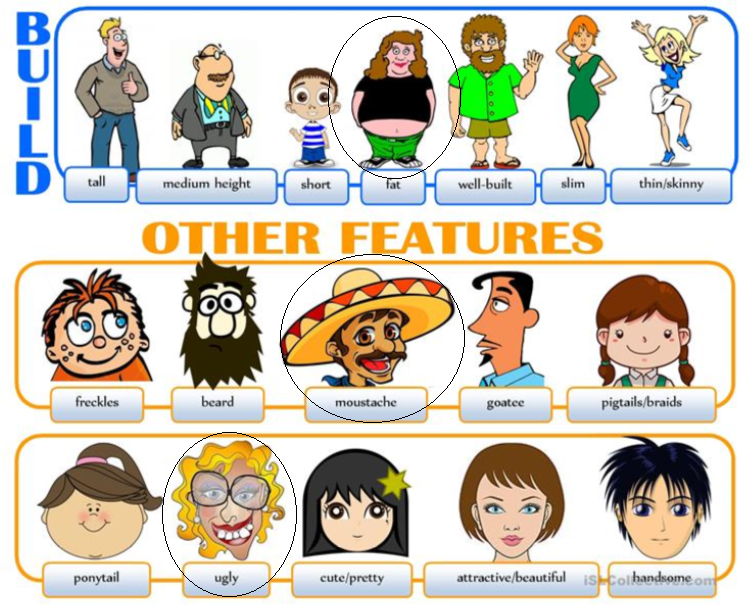
Firstly, have a look at the fat person. Do you notice how badly dressed they are? I bet everyone reading this post has already heard someone saying “She is fat, but she dresses really well”. It is a common misconception (hidden/unconcious¹ bias) that overweight people can’t dress properly. Well… that’s probably because fashion is not made for overweight people, but that is a topic for a whole new conversation.
Moving on, you can see an image of a stereotyped Mexican person serving as a model for a moustache (Mexican people don’t usually like to be portrayed that way, mind you). Lastly, while the pretty/handsome are anime characters, the ugly woman has wavy hair, wears glasses and has crooked teeth. Hey, wait a minute! My hair is wavy and quite messy because of it. I wear glasses and my teeth are not perfectly aligned, this means the ugly character suits me perfectly.
Handout 2: Analyse the picture before reading the next paragraph. Is it better, worse, the same as the previous one? Why are some characters circled?
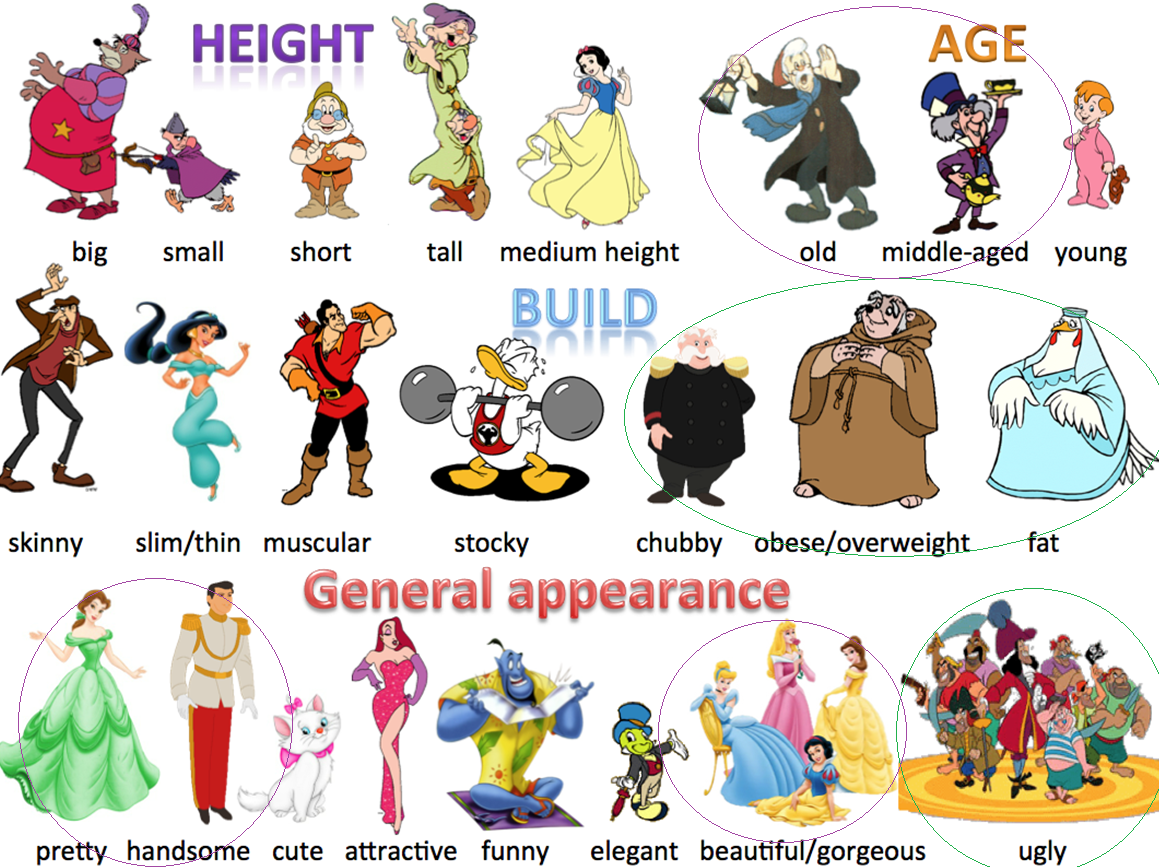
I guess we all agree that this handout is much better than the first one. First, look at the old person. It’s Geppetto and he looks great and active. Elderly people tend to be portrayed as sick, cute, slow, inactive, so we got a point here. Well done, Disney! I also love the fact that the overweight people are very elegant and important, instead of laid back, badly dressed, poor souls.
However, if we take a closer look at it, we see that only princes and princesses are portrayed as beautiful, handsome, or gorgeous, which would be okay if it weren’t for the ugly. Among the ugly people you see: the disabled, the foreigners, the poor, and people of colour. If this isn’t a strongly biased way of making ugly visual, I don’t know what else would be.
This goes to say that we need to critically look at the images we choose in our materials to make sure any of our students would feel offended by them. If most of the pictures look great but one student might feel offended by one of them, it is our duty as educators to replace that because we want each and everyone of our students to feel comfortable in our classrooms and not give more reasons for them to be bullied once again.
I challenge you to open google and look up “vocabulary physical appearance” and notice all sorts of hidden bias you notice in each one of the handouts you find online. Then, think about ways to adapt and make sure your new handout is more inclusive.
I guarantee you that your handouts will never be the same again and your students will never be able to thank you enough when they see their images represented in a positive and free of bias manner.
¹Any distortion of experience by an observer or reporter of which they are not themselves aware. This includes the processes of unintentional selectivity and transformation involved in perception, recall, representation, and interpretation. See also:
- addition
- assimilation
- deletion
- halo effect
- levelling and sharpening
- lookism
- nonverbal bias
- perceptual defence
- perceptual set
- receiver selectivity
- salience
- selective attention
- selective distortion
- selective exposure
- selective perception
- selective recall
- selective representation
- selective retention
- stereotyping
- substitution
- transposition
- typification
It also includes the influence of sociocultural frameworks on an observer or reporter, the cultural familiarity of which renders them transparent to them. See also:
- ethnocentrism
- gender bias
- interviewer bias
- male norm
- news values
- observer bias
- ocularcentrism
- phonocentrism
- proximity
- scriptism
See also bias. Check your hidden bias here.
Reference and handouts:
The Cultural Lens
PICTIONARY – physical description
English Adjectives for Describing Physical Appearance
About Cintia:
Cintia Rodrigues has been an ELT professional for 16 years. She holds an MA in Applied Linguistics (University of Bedfordshire), a BA in Linguistics (UNiversity of Sçao Paulo), CELTA and CPE. She is a teacher, teacher educator and is passionate about pronunciation, inclusive practices and diversity. She also volunteers for English to Trans-Form (Casa 1) and Voices BRAZ-TESOL SIG.
 Raise Up! - A Diverse And Inclusive View Of English Language Teaching
One thought on “Guest post: Sharpening Your Eye For Inclusion In Ready-Made Handouts by Cintia Rodrigues”